The fastest AI mistake is putting sensitive information into the wrong system. AI tools process information, and that is exactly why privacy and security must come before scale.
AI readiness is not about chasing software. It is about preparing the business to use AI with purpose, discipline, and accountability. The companies that win with AI will connect the technology to real work, real people, real process, and real measurement.
Why This Matters
Employees often paste customer emails, contracts, employee issues, pricing, operational problems, or internal notes into AI because they are trying to work faster. The intention may be good, but the risk may still be real.
This is an executive operating issue. AI can help a company move faster, but speed only matters when the direction is right. If the business problem is unclear, AI becomes noise. If the workflow is unclear, AI can automate confusion. If the data is weak, AI can create polished but unreliable output. If people are not trained, AI can increase risk instead of reducing friction.
What I Would Look For
I would start by looking at where the work slows down, where decisions repeat, where documents are recreated, where people copy information from one place to another, and where knowledge is trapped in people's heads. Then I would separate three categories: work AI can safely assist, work AI can help prepare but a human must approve, and work AI should not touch until governance is stronger.
Business Example
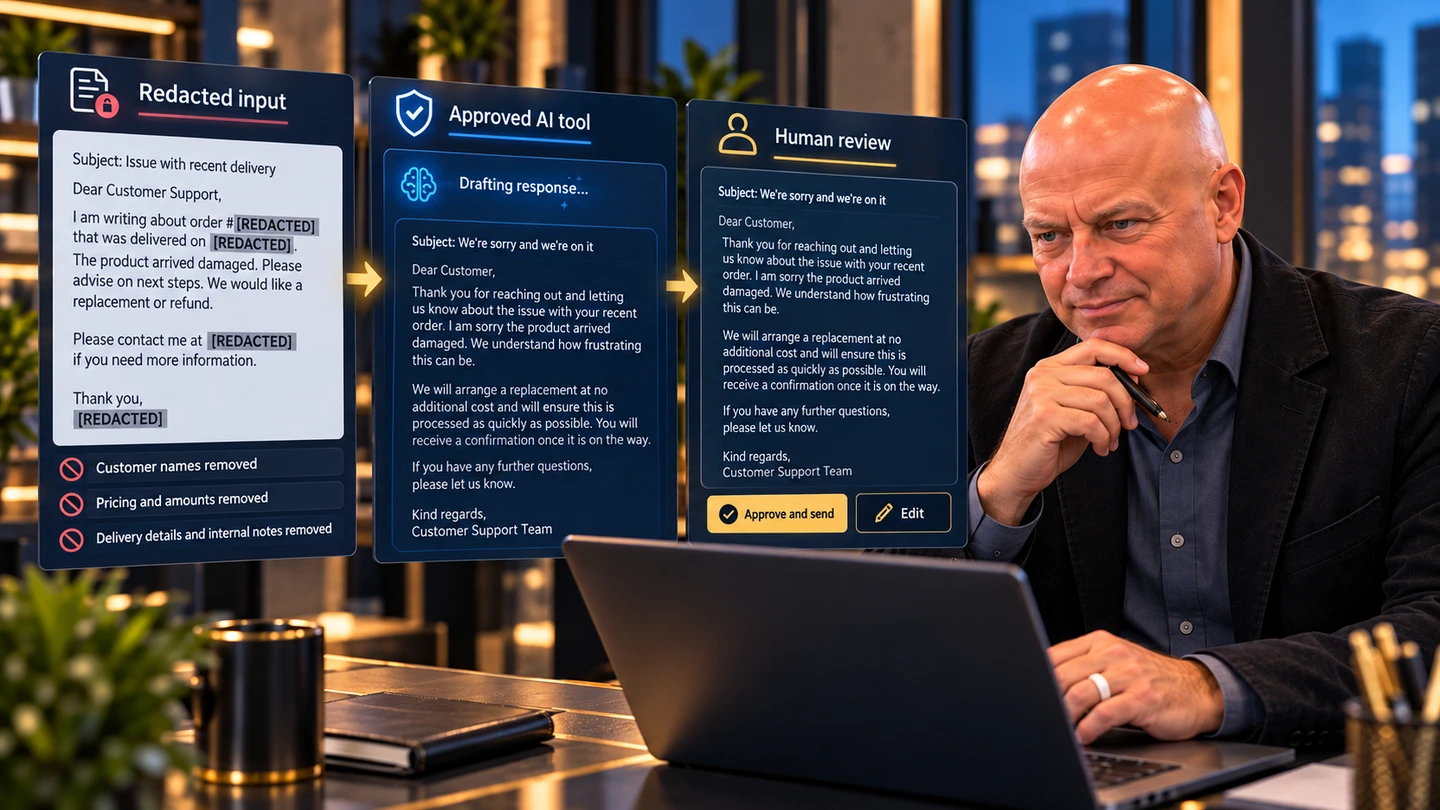
A manager wants help drafting a response to a customer complaint. If the manager copies the full complaint into a public tool, including names, pricing, delivery details, and internal notes, the company may expose sensitive information. A safer workflow uses approved tools, anonymized inputs, and human review.
The lesson is simple: AI should support the work, not hide the problem. It should help employees organize information, communicate clearly, reduce repetitive effort, and improve execution. It should not become a substitute for leadership, judgment, or accountability.
Risk If Ignored
Ignoring privacy and security can lead to data exposure, customer trust loss, employee privacy issues, legal exposure, cybersecurity vulnerabilities, and reputational damage.
This is where many companies get AI wrong. They move too fast in the wrong places and too slowly in the places that matter. They buy tools before defining use cases. They experiment without rules. They measure activity instead of impact. That approach may look innovative, but it is not disciplined.
Action Checklist
Ask these questions before moving forward: What business problem are we solving? Who owns the workflow? What information is being used? What human review is required? What risk could be created? How will employees be trained? How will success be measured? Who is accountable if the output is wrong?
Closing Thought
AI should make businesses clearer, faster, and more disciplined. It should help people turn knowledge into action. But that only happens when companies treat AI adoption as an operating capability, not a technology trend.
I help companies create AI guardrails around sensitive data so teams can use AI productively without creating avoidable privacy and security risk.
Sources Consulted - OWASP Top 10 for LLM Applications: https://owasp.org/www-project-top-10-for-large-language-model-applications/ - OWASP LLM01 Prompt Injection: https://genai.owasp.org/llmrisk/llm01-prompt-injection/ - NIST Generative AI Profile 2024: https://nvlpubs.nist.gov/nistpubs/ai/NIST.AI.600-1.pdf - IBM What is AI Governance: https://www.ibm.com/think/topics/ai-governance
← All insights